Published on November 3, 2025
Understanding the Mortgage Process: A Complete Guide for First-Time Homebuyers
Navigate the complex world of home financing with confidence. This comprehensive guide breaks down everything you need to know about mortgages, from choosing the right loan type to closing the deal.
Purchasing a home represents one of the most significant financial decisions you'll make in your lifetime. For many prospective homebuyers, the mortgage process can seem overwhelming and filled with unfamiliar terminology. Understanding how mortgages work, what lenders look for, and how to prepare yourself financially can transform this daunting journey into an empowering experience that leads to successful homeownership.
This comprehensive guide demystifies the mortgage process from start to finish. Whether you're a first-time homebuyer or looking to refinance, you'll gain valuable insights into mortgage types, qualification requirements, and strategies to improve your eligibility. We'll walk you through each step, providing expert advice and practical tools to help you make informed decisions about your home financing options.
The mortgage landscape has evolved significantly in recent years, with new loan products and digital application processes making homeownership more accessible. However, the fundamental principles of responsible borrowing and financial planning remain constant. By understanding these core concepts and preparing thoroughly, you'll position yourself for mortgage approval and long-term financial success.
Understanding Different Mortgage Types
The mortgage market offers various loan products designed to meet different financial situations and homeownership goals. Selecting the right mortgage type is crucial for your long-term financial health and requires careful consideration of your current circumstances and future plans. Each mortgage type comes with distinct advantages, requirements, and potential drawbacks that can significantly impact your monthly payments and overall cost of homeownership.
Fixed-Rate Mortgages represent the most traditional and predictable option for homebuyers. With this loan type, your interest rate remains constant throughout the entire loan term, typically 15 or 30 years. This stability provides peace of mind and makes budgeting straightforward, as your principal and interest payments never change. Fixed-rate mortgages are particularly attractive when interest rates are low, allowing you to lock in favorable terms for decades. They're ideal for buyers who plan to stay in their homes long-term and value payment predictability over potential short-term savings.
Adjustable-Rate Mortgages (ARMs) offer lower initial interest rates that adjust periodically based on market conditions. Common ARM structures include 5/1, 7/1, or 10/1 configurations, where the first number indicates how many years the initial rate remains fixed, and the second number shows how often the rate adjusts afterward. ARMs can provide significant savings during the initial fixed period, making them attractive for buyers who plan to sell or refinance before the adjustment period begins. However, they carry the risk of payment increases if interest rates rise, requiring careful financial planning and risk tolerance assessment.
FHA Loans, backed by the Federal Housing Administration, cater specifically to first-time homebuyers and those with limited down payment funds or lower credit scores. These government-insured loans require as little as 3.5% down and accept credit scores as low as 580, making homeownership accessible to a broader range of buyers. FHA loans do require mortgage insurance premiums (MIP) for the life of the loan if you put down less than 10%, which increases your monthly payment. Despite this additional cost, FHA loans remain an excellent option for buyers who might not qualify for conventional financing.
VA Loans provide exceptional benefits for eligible veterans, active-duty service members, and qualifying spouses. Guaranteed by the Department of Veterans Affairs, these loans require no down payment and no private mortgage insurance, resulting in lower monthly payments and reduced upfront costs. VA loans also typically offer competitive interest rates and more flexible credit requirements than conventional mortgages. If you qualify for a VA loan, it often represents the most advantageous financing option available, potentially saving tens of thousands of dollars over the life of the loan.
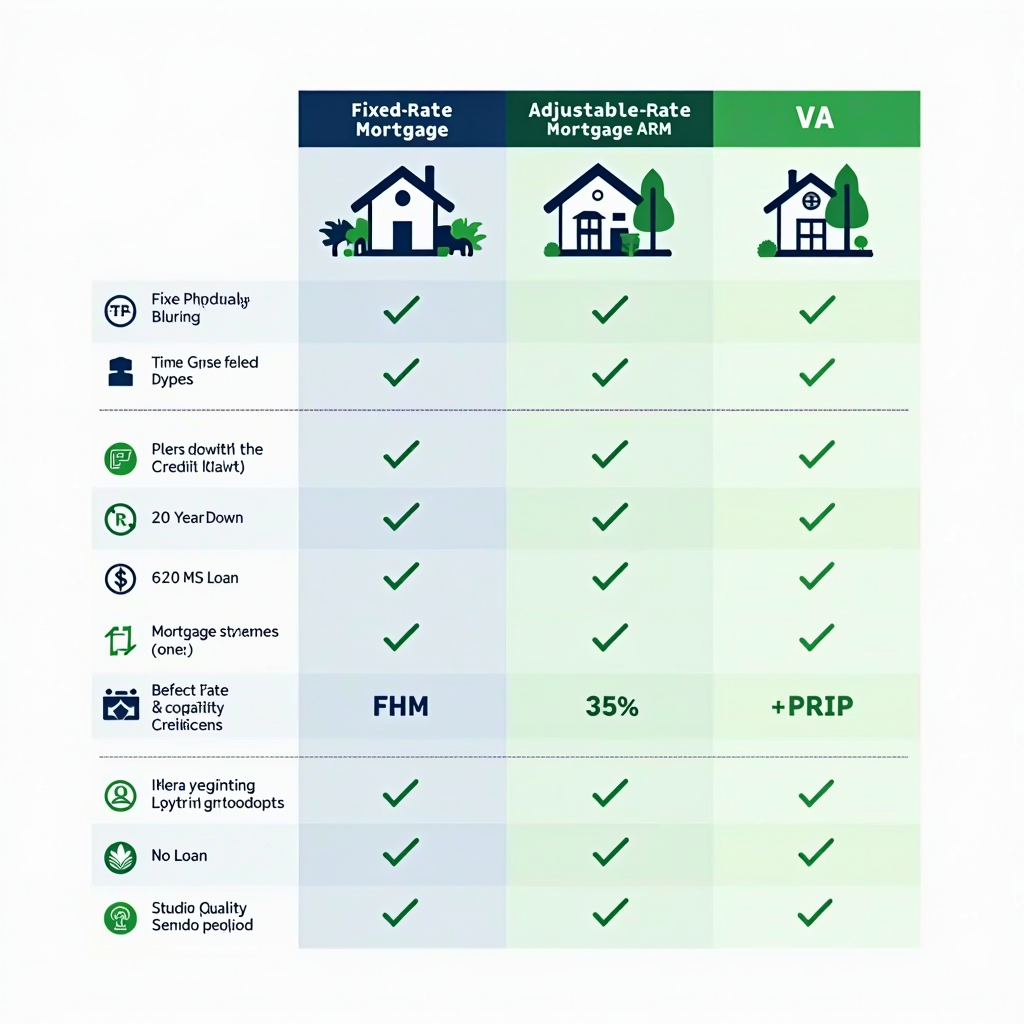
Comparison of major mortgage types and their key characteristics
Down Payment Requirements and Strategies
The down payment represents one of the most significant hurdles for prospective homebuyers, yet understanding your options can make this challenge more manageable. While the traditional 20% down payment remains the gold standard for avoiding private mortgage insurance (PMI) and securing the best interest rates, numerous programs and strategies exist for buyers with smaller savings. Your down payment amount affects not only your upfront costs but also your monthly payments, loan terms, and overall financial flexibility.
Conventional loans typically require between 3% and 20% down, with the exact amount influencing your interest rate and whether you'll pay PMI. Putting down less than 20% triggers PMI requirements, adding $30 to $70 per month for every $100,000 borrowed, depending on your credit score and loan-to-value ratio. However, PMI can be removed once you reach 20% equity through payments or home appreciation, making it a temporary cost rather than a permanent burden. Many buyers strategically choose to put down less initially, preserving cash for home improvements, emergency funds, or other investments.
First-time homebuyer programs offer valuable assistance through down payment grants, low-interest loans, and tax credits. Many state and local housing authorities provide programs requiring as little as 0-3% down, with some offering forgivable loans that don't require repayment if you remain in the home for a specified period. These programs often include homebuyer education requirements, which provide valuable financial literacy training alongside financial assistance. Research programs in your area early in your home search, as funding is often limited and application processes can take several weeks.
Building your down payment requires disciplined saving and strategic financial planning. Consider opening a dedicated high-yield savings account specifically for your home fund, automating monthly transfers to ensure consistent progress. Explore additional income sources through side hustles or freelance work, directing all extra earnings toward your down payment goal. Some buyers successfully leverage gift funds from family members, though lenders require documentation proving the money is a gift rather than a loan. Tax refunds, work bonuses, and proceeds from selling assets can also accelerate your savings timeline significantly.
Navigating Closing Costs and Additional Expenses
Beyond the down payment, homebuyers must prepare for closing costs, which typically range from 2% to 5% of the purchase price. These expenses cover various services and fees required to complete your home purchase, and understanding them helps prevent last-minute financial surprises. Closing costs encompass everything from loan origination fees and appraisal costs to title insurance and attorney fees, creating a substantial additional expense that many first-time buyers underestimate.
Lender fees constitute a significant portion of closing costs, including the loan origination fee (typically 0.5% to 1% of the loan amount), application fees, and underwriting charges. You'll also pay for the home appraisal ($300-$500), credit report fees ($25-$50), and potentially discount points if you choose to buy down your interest rate. Understanding these costs upfront allows you to shop around for lenders and negotiate fees, potentially saving hundreds or thousands of dollars. Request a Loan Estimate from multiple lenders within a short timeframe to compare costs without impacting your credit score significantly.
Title-related expenses protect both you and your lender from ownership disputes and ensure clear property transfer. Title search fees ($200-$400) verify the seller's legal right to sell the property, while title insurance (0.5% to 1% of purchase price) protects against future claims. You'll also pay for the title company's settlement services, document preparation, and recording fees to officially register the property transfer with local authorities. While these costs seem excessive, they provide crucial protection for what may be your largest investment.
Prepaid expenses and escrow deposits require you to pay certain costs in advance at closing. These include prepaid homeowners insurance (typically one year upfront), property taxes (prorated based on closing date), and initial escrow deposits for future tax and insurance payments. You may also pay prepaid interest covering the period from closing until your first mortgage payment. Some buyers negotiate seller concessions, where the seller agrees to pay a portion of closing costs, effectively reducing your out-of-pocket expenses. This strategy works particularly well in buyer's markets or when purchasing properties that have been listed for extended periods.
How Lenders Evaluate Mortgage Applications
Understanding the mortgage underwriting process demystifies what lenders look for and helps you prepare a stronger application. Lenders evaluate your financial profile using several key criteria, collectively assessing your ability and willingness to repay the loan. This evaluation process, while thorough, follows predictable patterns that allow you to optimize your financial position before applying. The better you understand these criteria, the more effectively you can address potential weaknesses and highlight your strengths.
Your credit score serves as the foundation of mortgage qualification, with most conventional loans requiring a minimum score of 620, though higher scores unlock better interest rates. Lenders examine your credit history for payment patterns, outstanding debts, and any negative marks like bankruptcies or foreclosures. A score above 740 typically qualifies you for the best rates, while scores between 620 and 739 result in higher interest rates that can cost tens of thousands of dollars over the loan term. Review your credit reports from all three bureaus at least six months before applying, disputing any errors and addressing negative items proactively.
The debt-to-income ratio (DTI) measures your monthly debt obligations against your gross monthly income, with most lenders preferring a DTI below 43% for conventional loans. This calculation includes your proposed mortgage payment, property taxes, insurance, HOA fees, and all other monthly debt payments like car loans, student loans, and credit cards. A lower DTI demonstrates greater financial flexibility and reduces lender risk. Calculate your DTI by dividing total monthly debt payments by gross monthly income, then multiply by 100 to get a percentage. If your DTI exceeds lender limits, focus on paying down debts or increasing income before applying.
Employment history and income stability provide lenders confidence in your ability to make consistent mortgage payments. Most lenders require at least two years of steady employment, preferably in the same field or with increasing responsibility and compensation. Self-employed borrowers face additional scrutiny, typically needing two years of tax returns showing consistent or growing income. Lenders verify employment directly with employers and may request pay stubs, W-2s, and tax returns. Avoid changing jobs during the mortgage process, as employment gaps or career changes can delay or derail your application. If a job change is unavoidable, ensure it represents a clear advancement in the same field with comparable or higher compensation.
Cash reserves demonstrate financial responsibility and provide a safety net for unexpected expenses or income disruptions. Lenders want to see that you'll have money remaining after closing, typically requiring reserves equivalent to two to six months of mortgage payments. These reserves can include savings accounts, retirement accounts (with some restrictions), and investment accounts. Larger reserves may help offset other application weaknesses, such as a higher DTI or lower credit score. Document all assets clearly, providing statements showing consistent balances rather than sudden large deposits that might raise questions about the source of funds.
Expert Strategies for Improving Mortgage Eligibility
Strengthening your mortgage application requires strategic financial planning and disciplined execution over several months or even years. The good news is that most aspects of mortgage qualification are within your control, allowing you to systematically improve your profile. By focusing on key areas that lenders evaluate, you can transform a marginal application into a strong one, potentially saving thousands of dollars through better interest rates and loan terms.
Improving your credit score should be your first priority, as it affects both qualification and interest rates. Start by paying all bills on time, as payment history accounts for 35% of your credit score. Reduce credit card balances to below 30% of available credit limits, ideally below 10% for maximum impact. Avoid opening new credit accounts or making large purchases on credit in the six months before applying for a mortgage. If you have collections or charge-offs, consider negotiating pay-for-delete agreements or settling debts for less than the full amount. Each 20-point increase in your credit score can reduce your interest rate by 0.125% to 0.25%, translating to significant long-term savings.
Reducing your debt-to-income ratio requires either decreasing debt or increasing income, preferably both. Focus on paying off smaller debts completely rather than spreading payments across multiple accounts, as eliminating entire monthly obligations has the greatest DTI impact. Consider taking on a side job or freelance work to boost income, ensuring you maintain this additional income source for at least two years to satisfy lender requirements. If you receive regular bonuses or commissions, document this income thoroughly, as lenders may count it toward your qualifying income after verifying its consistency. Avoid taking on new debt, including car loans or large credit card balances, during the mortgage application process.
Building substantial cash reserves demonstrates financial responsibility and provides a cushion for unexpected expenses. Automate savings by setting up direct deposits or automatic transfers to a dedicated savings account, treating your down payment fund as a non-negotiable monthly expense. Reduce discretionary spending by tracking expenses and identifying areas for cuts, redirecting these savings toward your home fund. Consider temporarily reducing retirement contributions to accelerate down payment savings, though balance this against long-term retirement goals and any employer matching you might forfeit. Some buyers successfully leverage windfalls like tax refunds, inheritances, or work bonuses to jumpstart their savings.
Gathering documentation early streamlines the application process and demonstrates preparedness to lenders. Create a comprehensive file including two years of tax returns, recent pay stubs, bank statements, investment account statements, and documentation of any additional income sources. If you're self-employed, organize profit and loss statements, business tax returns, and evidence of business stability. Address any unusual deposits or financial transactions proactively, preparing written explanations for anything that might raise questions. This preparation not only speeds up the approval process but also helps you identify and address potential issues before they become obstacles.
Essential Documentation Checklist
Use this comprehensive checklist to gather all necessary documents before starting your mortgage application. Having these items ready will expedite the approval process and demonstrate your preparedness to lenders.
Income Documentation
- Last 2 years of federal tax returns (all pages)
- Last 2 years of W-2 forms
- Recent pay stubs (last 30 days)
- Proof of additional income (bonuses, commissions, rental income)
- For self-employed: 2 years of business tax returns and profit/loss statements
Asset Documentation
- Last 2-3 months of bank statements (all accounts)
- Investment account statements
- Retirement account statements (401k, IRA)
- Documentation of gift funds (if applicable)
- Explanation letters for large deposits
Credit & Debt Information
- Credit reports from all three bureaus
- List of all current debts and monthly payments
- Loan statements for auto loans, student loans
- Credit card statements
- Bankruptcy or foreclosure documentation (if applicable)
Personal & Property Documents
- Valid government-issued photo ID
- Social Security card or verification
- Proof of residence (utility bills, lease agreement)
- Purchase agreement (once under contract)
- Homeowners insurance quote
Pro Tip: Organize these documents in clearly labeled folders (physical or digital) and make copies for your records. Having everything readily accessible will significantly speed up the application process and help you respond quickly to any lender requests.
Taking the Next Steps Toward Homeownership
The mortgage process, while complex, becomes manageable when you understand its components and prepare systematically. By familiarizing yourself with different mortgage types, understanding lender requirements, and implementing strategies to strengthen your financial profile, you position yourself for successful homeownership. Remember that mortgage qualification is not a one-time event but rather the culmination of months or years of financial planning and disciplined money management.
Start your journey by assessing your current financial situation honestly and identifying areas for improvement. Use the documentation checklist provided to begin gathering necessary paperwork, and consider consulting with a mortgage professional to get pre-qualified. This preliminary step provides valuable insights into your borrowing capacity and helps you set realistic homeownership goals. Many buyers find that working with a knowledgeable loan officer early in the process helps them avoid common pitfalls and optimize their application strategy.
Remember that improving your mortgage eligibility often requires time and patience. Focus on the factors within your control—building your credit score, reducing debt, increasing savings, and maintaining stable employment. These efforts not only improve your chances of mortgage approval but also establish healthy financial habits that will serve you well throughout homeownership. The discipline required to qualify for a mortgage translates directly into the financial responsibility needed to maintain a home and build long-term wealth.
Homeownership represents more than just a financial transaction—it's a significant life milestone that provides stability, builds equity, and creates opportunities for your future. By approaching the mortgage process with knowledge, preparation, and realistic expectations, you transform what seems like an overwhelming challenge into an achievable goal. Take the first step today by reviewing your finances, checking your credit, and beginning to gather the documentation you'll need. Your journey to homeownership starts with understanding, and this guide has equipped you with the knowledge to move forward with confidence.
About the Author
Sarah Mitchell is a certified financial planner with over 12 years of experience in mortgage lending and personal finance education. She has helped hundreds of first-time homebuyers navigate the mortgage process and achieve their homeownership dreams. Sarah holds a Master's degree in Financial Planning and regularly contributes to leading financial literacy platforms. Her expertise lies in demystifying complex financial concepts and providing practical, actionable advice for everyday money management.